
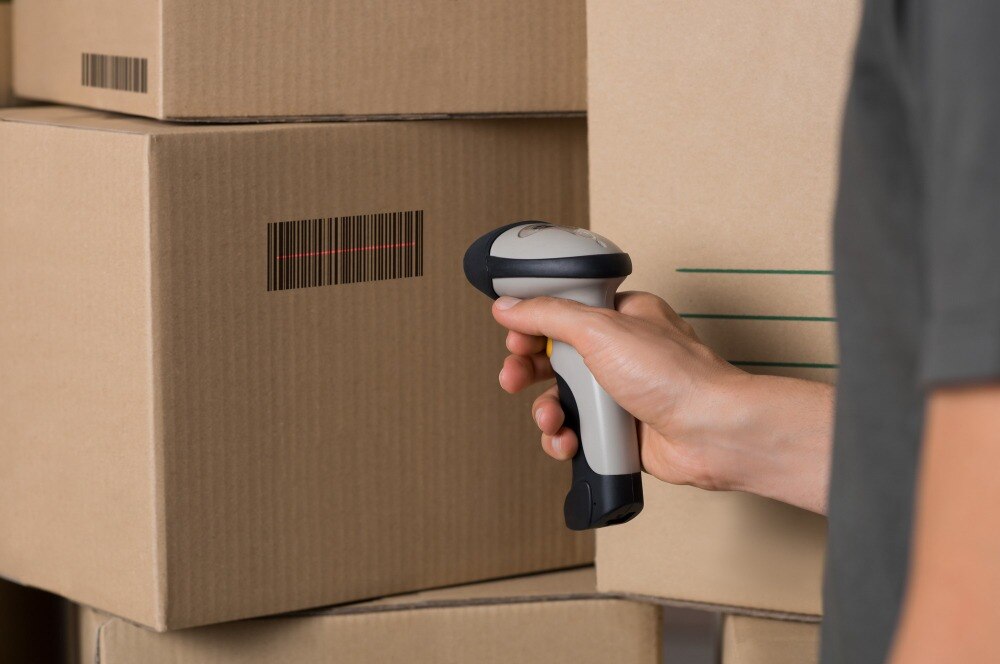
Dispersed offices, unlabelled equipment, duplicate records and uncontrolled transfers make fixed-asset verification slow and unreliable. You will learn how to match barcode, passive UHF RFID or a hybrid approach to each asset class, then implement controls that produce defensible inventory records across Indian operating conditions.
Key takeaways
- Use barcodes for deliberate one-at-a-time checks with visible labels.
- Use passive UHF RFID for bulk reads where line of sight is obstructed.
- Choose hybrid tags when staff need both rapid reads and visual confirmation.
- Test read zones against metal, liquids, walls and nearby tagged assets.
How Barcode RFID Addresses India’s Most Common Asset-Tracking Failures
Barcode and RFID solve different failures: barcode requires a deliberate optical scan with line of sight, while passive UHF RFID can detect multiple tagged assets without line of sight. That distinction matters in barcode RFID for asset tracking problems in India, where regional offices, warehouses and plant rooms make manual counts slow.
| Option | Reading behaviour | Best fit | Main limitation |
|---|---|---|---|
| Barcode | One visible label scanned individually | Laptops, furniture and accessible equipment | Misses hidden, unlabelled or obstructed assets |
| Passive UHF RFID | Multiple tags read without line of sight | Bulk counts, storage areas, gates and transfer points | Requires controlled read zones to interpret movement |
| Hybrid tag | RFID read plus printed identifier | Fast counts with human verification | Higher tag and deployment cost |
Use barcodes where each asset is presented to a person. Use RFID where high volumes, office-to-office transfers, weak movement controls or unattended reads create delays. Neither technology repairs duplicate records by itself; each tag must map to one controlled asset ID, while unlabelled assets need a new record or exception decision.
RFID detects a tag, not its exact room, owner or condition. Room-level evidence requires controlled read zones, antennas or additional location infrastructure, and records still need human verification.
Reconcile three populations:
- Assets in the fixed-asset register
- Assets physically found
- Assets found but absent from the register
This separates missing, relocated, duplicate, untagged and found-but-unrecorded assets instead of calling every mismatch theft.
Barcode, RFID or Hybrid Tags: Which Option Fits Your Assets?
Choose barcode for predictable, low-cost control of individually presented assets; choose passive UHF RFID when volume, distance or unattended reading makes deliberate scanning too slow. Hybrid tags cover both needs.
| Option | Scanning, distance and speed | Capacity, durability, interference, effort and cost |
|---|---|---|
| Barcode label | Requires line of sight and a deliberate optical scan; usually one nearby asset at a time | Stores a short identifier; inexpensive and quick to install, but needs a clean, visible surface and can fail when scratched, dirty or covered |
| Passive UHF RFID | Reads without line of sight, across a longer distance, and counts many tagged assets quickly | Stores an identifier plus limited tag memory; costs more and needs reader tuning, antennas and acceptance testing; metal, batteries and liquids can block or detune reads |
| Hybrid barcode-RFID | RFID supports bulk counts, gates and zones; barcode supports close inspection and exception work | Costs more than barcode alone but provides a printed, human-readable fallback when radio reads fail or maintenance staff lack an RFID reader |
Barcode remains economical for laptops, furniture and accessible equipment that you present individually. RFID suits crowded stores, high asset volumes, unattended movement events, gates and controlled zones.
Many barcode RFID India projects use passive UHF at 865–867 MHz with EPC Class 1 Gen 2 or ISO 18000-63-compatible equipment. Confirm Indian regulatory approval, reader power and channel settings instead of copying a foreign configuration.
Ordinary labels perform poorly on metal racks, electrical panels, batteries and liquid containers. Use on-metal tags, spacers, flag tags or another mounting position. Compare barcode RFID solutions India vendors on first-pass reads, false reads and total deployment cost—not claimed range alone.
How a Barcode RFID Asset Check Works Across Indian Sites
A usable audit trail starts with a clean asset record, not a reader. In barcode rfid asset tracking india projects, each tag must map to one immutable asset ID, while retired IDs remain blocked from reuse.
- Confirm the record: asset description, serial number, custodian, site, room, status and register ID. Resolve duplicates before tagging.
- Encode that ID in the barcode, RFID memory or hybrid tag, then attach it where staff can reach and inspect it. Avoid removable covers, service panels and surfaces that hide the tag.
- Scan with a handheld imager or RFID reader. Record the asset, user, device, timestamp, site, room or zone and action history.
- Use handheld readers across office floors and crowded plant rooms. Fixed readers with controlled antennas suit gates, storage zones and unattended movement events, but detection alone does not prove exact room location, ownership or condition.
- Capture offline when a regional site, basement or plant room loses connectivity, then synchronise after reconnection without overwriting prior events.
- Reconcile found, missing, relocated, duplicate, untagged and found-but-unregistered assets against the fixed-asset register.
- Generate exception reports and assign each discrepancy for investigation and closure.
Test the process in dusty warehouses, high-temperature areas, monsoon moisture, metal shelving, multi-floor offices and crowded machinery spaces. A claimed read range is not a KPI: acceptance testing must measure first-pass reads, missed reads and false reads across the actual asset mix, shelf arrangement and antenna orientations.
A Step-by-Step Implementation Plan for Reliable Asset Identification
Start with the database, not the tag. A reliable barcode RFID solutions india deployment gives each physical asset one confirmed record, one controlled identifier and an auditable history.
- Cleanse the master data, then compare the register with physical findings.
- Resolve duplicate assets and close retired or disposed records before tagging.
- Define an immutable numbering scheme; block every retired ID from reuse.
- Specify placement: laptops on the chassis, servers on the rack-accessible frame, furniture underneath a fixed surface, electrical panels and machinery on durable visible faces, tools on handles or bodies, vehicles on protected frames, and returnable equipment on inspectable fixed surfaces. Never use removable covers or service panels.
- Select indoor, outdoor, tamper-resistant or on-metal tags according to exposure, metal, heat, moisture and handling.
- Pilot difficult representative assets, including metal panels, batteries, liquids, machinery and crowded storage—not only chairs or cartons.
- Choose handheld readers for verification, fixed readers for controlled gates or zones, and mobile readers where vehicles or connectivity require them.
- Train users, roll out site by site, then check first-pass reads, duplicates, exceptions and register reconciliation after implementation.
| Option | Best fit | Main limitation |
|---|---|---|
| Barcode | Individually presented laptops and furniture | Needs line of sight and deliberate scanning |
| Passive UHF RFID | Bulk counts, gates and crowded storage | Metal and liquids can shield or detune tags |
| Hybrid | Fast RFID counts plus visible fallback | Higher tag and installation cost |
Do not encode inconsistent IDs, ignore duplicates, use paper labels in harsh areas, or treat a scan as proof of ownership or condition. Welcome to V SOURCING can support data preparation, tagging, verification and technology implementation while your organisation retains control ownership.
Related products
BARCODE/RFID Barcodes and Radio-Frequency Identification (RFID) are both technologies used for tracking and managing information about objects. View product → |
FIXED ASSET PHYSICAL VERFICATION TAGGING & BARCODING SERVICES FIXED ASSET PHYSICAL VERFICATION TAGGING & BARCODING SERVICES Fixed Asset Physical Verification and Tagging entails the following activities : Comprehensive and complete physical verification exercise of all the... View product → |
How to Measure Results and Keep Read Zones Trustworthy
A deployment is fixed only when the original control failure becomes measurable after go-live. A practical pilot for barcode RFID for asset-tracking problems in India should use difficult, representative assets—not only chairs or cartons—and establish a baseline before rollout.
- Record the percentage of assets successfully tagged, first-pass read rate, duplicate-read rate, time per asset or zone, manual exception count and reconciliation closure time. Repeat these measures by site during rollout and compare them with the baseline for barcode RFID asset tracking in India.
- Reconcile three populations: assets in the fixed-asset register, assets physically found and assets found but absent from the register. Classify each mismatch as missing, relocated, duplicate, untagged, disposed-but-open or found-but-unrecorded; never label every mismatch theft.
- Require every scan or read to retain the user, device, timestamp, location and action history. For co-located similar assets, show the serial number, model and custodian, then force review when tag identity conflicts with the register.
- Test each read zone periodically, check antenna and reader health, review shelf layouts, control replacement of damaged labels and approve every tag substitution. Block retired tag IDs from reuse.
RFID speeds counting; governance and reconciliation make the result reliable. A detected tag is not proof of ownership, condition or exact room location.
Frequently asked questions
Should you choose barcode, RFID or hybrid tags for asset tracking?
Choose barcodes for deliberate optical scans, passive UHF RFID for multiple reads without line of sight, and hybrid tags when you need both capabilities.
How does a barcode RFID asset check work across Indian sites?
Prepare the asset register, inspect labels, scan barcodes or read RFID tags, record exceptions and reconcile results by site, room and custodian.
What should you test before implementing barcode RFID asset tracking in India?
Test tag adhesion, barcode readability, RFID read performance and read zones around metal, liquids, walls, racks and other sources of interference.
How do you keep RFID read zones trustworthy?
Map each zone, test known tagged assets, record missed and duplicate reads, adjust reader power or antenna placement, and repeat validation after layout changes.
Keywords