A low quote can still leave you with unverified assets, failed labels, duplicate IDs and a register that cannot withstand audit review. Use the scope, pilot, technology tests, data controls and contract terms below to compare providers and select a service that produces reliable evidence rather than a spreadsheet of scanned items.
Key takeaways
- Demand exception registers, controlled workpapers and location-level reconciliation.
- Specify tag materials by surface, environment, asset value and expected service life.
- Use barcodes for line-of-sight scans; choose RFID for faster non-line-of-sight reads.
- Keep ownership, cost, location and custody details in the asset register.
What should a Mumbai verification provider deliver beyond an asset count?
For physical asset verification in Mumbai, demand an exception register and controlled workpapers, not a spreadsheet of scanned items. Before mobilisation, define whether the assignment is a 100% census or a sample-based procedure; sampling cannot support a claim that every asset exists.
1. Require evidence of existence, completeness, location, custodian, condition, ownership and reconciliation to the fixed asset register. Capture serial numbers, detect duplicate IDs, report missing assets, identify found-not-in-register items and list register entries with no physical counterpart.
2. Require floor-to-book testing: locate physical assets that have no register record, identify them and propose controlled additions. Require book-to-floor testing: trace each register entry to its stated physical location and record an in-register-not-found result when it cannot be located.
3. Require exception codes for wrong locations, wrong custodians, unreadable or missing tags, disposed assets still listed, assets under repair or transfer, and serial-number mismatches. Ask how inaccessible areas and assets in transit will be recorded, who authorizes status changes and whether original records remain preserved.
4. Require a workpaper containing the source register, timestamp, verifier identity, asset identifier, location hierarchy, status, exception code, required photographs and reviewer sign-off. Corrections should be re-performed against the original result, not overwrite it.
5. When choosing fixed asset for tagging barcoding services in Mumbai, ask how reporting supports discrepancies for each Property, Plant and Equipment class, including the 10% aggregate threshold referenced in the Companies (Auditor’s Report) Order, 2020.
How should you compare tag materials across Mumbai sites and asset classes?
Request a pilot before approving a city-wide rollout of asset tagging options in Mumbai. Test painted metal, stainless steel, plastic, wood, glass, dusty equipment, outdoor assets, and surfaces exposed to cleaning chemicals or heat.
| Material | Best fit | Procurement checks |
|---|---|---|
| Durable polyester | Office furniture and indoor equipment | Face-stock, adhesive, laminate, cleaning resistance and service life |
| Engraved or anodised plate | Harsh machinery and electrical panels | Corrosion resistance, abrasion resistance and temperature range |
| On-metal RFID tag | Metal equipment requiring radio scanning | Frequency, protocol, read rate by orientation and reader configuration |
| Spacer-mounted tag | Metal surfaces where an inlay would detune | Air gap, mounting strength, moisture resistance and replacement method |
Mumbai’s monsoon humidity, coastal salinity, dust, air-conditioning condensation and frequent cleaning can cause adhesive failure, corrosion, print degradation or unreadable labels. Specify the face-stock, adhesive, laminate, chemical resistance, operating-temperature range, expected service life, and whether the tag is for indoor, sheltered-outdoor or exposed-outdoor use; reject a generic “outdoor” claim.
Check adhesion after cleaning, abrasion and moisture exposure, then record failed labels and replacement time rather than measuring initial adhesion alone. Place each tag where it remains visible for scanning, protected from routine damage, reachable without dismantling equipment and consistent across the asset class.
For high-value or theft-prone equipment, compare tamper-evident labels with a second hidden identifier. Price the added label cost and the replacement complexity before selecting them.
When is a barcode or RFID specification suitable for your site?
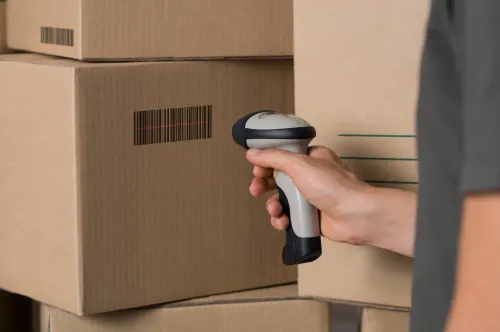
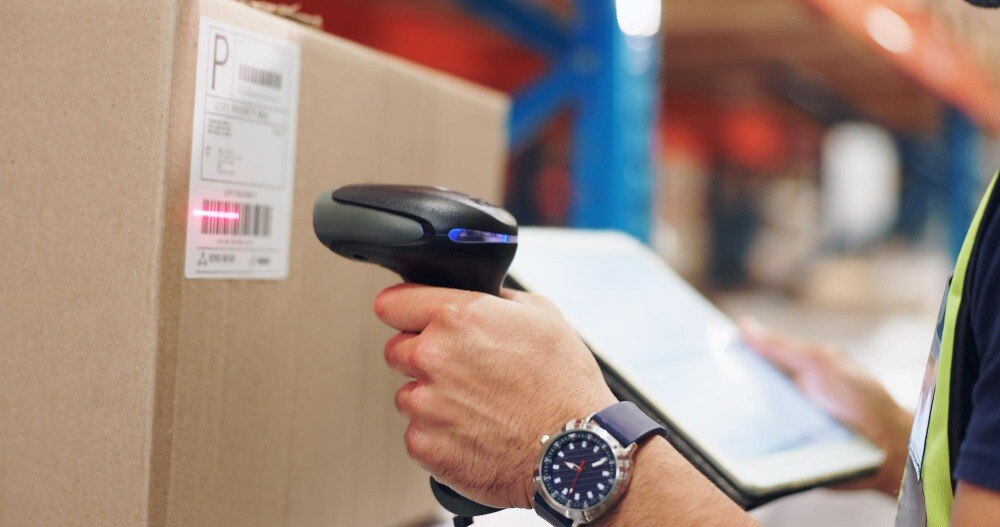
Measure the site before choosing the carrier. Record read distance, line-of-sight access, scanning speed, tag and reader cost, and the accuracy required. Code 128 suits scanner-accessible labels; QR Code or Data Matrix suits camera-based capture when each label remains reachable.
| Option | Best fit | Main limitation |
|---|---|---|
| Code 128 | Linear scanner and clear label access | Requires line of sight and adequate label width |
| QR Code or Data Matrix | Camera capture and more encoded data | Needs a reachable, clean label and reliable lighting |
| UHF RFID | Rapid non-line-of-sight reads | Performance changes with materials, orientation and reader setup |
Choose UHF RFID only after testing the proposed frequency, protocol, reader, antenna configuration, read-zone design, collision handling, and handheld-versus-fixed-reader workflow. Metal, liquids, dense shelving, tag orientation, reader power and electromagnetic interference can reduce performance. A standard label-style UHF inlay placed directly on metal can become unreadable.
Require measured read rates by asset class and orientation, not a supplier’s nominal range. For barcodes, specify symbology, minimum quality grade, quiet zones, label dimensions, print contrast and durability. Verify two-dimensional symbols under ISO/IEC 15415 and linear barcodes under ISO/IEC 15416 with a barcode verifier, not one successful scan.
Define isolation, retesting and replacement for unreadable labels. “RFID-enabled” without these controls is not a usable specification for a barcode asset tagging provider in Mumbai.
What should the tag show, and what belongs in the asset register?
Use a non-reused asset identifier as the primary barcode or RFID value. Print the asset ID, company name, barcode value, and a contact or ownership identifier when those details help a finder return the item.
Label | Asset register or connected EAM system Asset ID and barcode value | Description and asset class Company name and return contact | Acquisition cost and financial data | Location, custodian and maintenance status | Transfer history and disposal status
Do not print the full description or location. An asset that moves or changes status will make that label obsolete.
Test the label against the smallest surface in the pilot. Check label dimensions, barcode quiet zones, print contrast and placement before approving a rollout.
Require the capture system to provide:
- Offline mobile capture for unreliable connectivity
- Serial-number validation and duplicate-ID prevention
- Import templates and location hierarchies
- ERP or EAM integration
- Controlled correction workflows
Ask who owns the cleaned master data and who can approve a correction. A neat label project still fails when identifiers cannot reconcile to the ledger or maintenance system.
The replacement procedure must cover damaged, missing and unreadable tags. Require re-tagging approval, preservation of the old ID in the audit trail, and a system check confirming that the replacement cannot create a duplicate. For important assets, retain a photograph and hidden identifier in the verification record.
What should the statement of work and provider comparison include?
Put every bid against the same itemised statement of work; otherwise a low price may simply exclude reconciliation or annual verification.
| Scope item | Require the bid to state |
|---|---|
| Survey labour | Team size, daily capacity and coverage of offices, warehouses and plants |
| Label or tag supply | Material, adhesive, durability, failed-tag replacement policy and unit price |
| Printing and installation | Print controls, placement rules, installation rate and re-tagging approval |
| Reconciliation | Register import template, serial validation, duplicate-ID prevention and ERP/EAM export |
| Report generation | Exception register, reconciliation file, photographs, location hierarchy and reviewer sign-off |
| Future annual verification | Unit rates, assumptions, repeat identification rules and escalation timetable |
Require a pilot acceptance test with named deliverables, measured read-rate or scan-quality targets, controlled exception re-performance and replacement pricing. Set a deadline for correcting discrepancies instead of accepting a revised file with no audit trail.
Specify access arrangements, working hours, escort rules, field-team identification, background checks and plant safety requirements. State how teams will record assets under repair, transfer or temporary storage, including who grants access and approves status changes.
Ask for sample outputs before award: the exception register, reconciliation file, location hierarchy, photographs, reviewer sign-off and export format. Confirm that offline capture, timestamps and verifier identity survive export.
Welcome to V SOURCING belongs on the shortlist only if its managed work demonstrates these controls in your asset classes; a polished label or large field team proves little. The contract must preserve the original register, identify cleaned-register ownership, prevent duplicate replacements and require the same rules next year.
Related products
FIXED ASSET PHYSICAL VERFICATION TAGGING & BARCODING SERVICES FIXED ASSET PHYSICAL VERFICATION TAGGING & BARCODING SERVICES Fixed Asset Physical Verification and Tagging entails the following activities : Comprehensive and complete physical verification exercise of all the... View product → |
IT SERVICES At V Sourcing we provide you with best in Class IT with our Homegrown products that can service your complete business needs. View product → |
Frequently asked questions
What should a physical verification provider deliver beyond an asset count?
Require controlled workpapers, an exception register, location-level reconciliation and a clear statement of whether the assignment was a 100% census or sample-based procedure.
How should you compare asset tag materials across Mumbai sites?
Compare adhesive performance, surface type, heat, humidity, dust, cleaning chemicals, sunlight exposure, tamper resistance and the expected life of each asset.
When is barcode or RFID tagging suitable for a site?
Choose barcodes when staff can reach and scan each asset with line of sight. Choose RFID when faster reads, non-line-of-sight identification or high-volume movement justifies the added infrastructure and testing.
What belongs on the tag and what belongs in the asset register?
Put a readable asset identifier and barcode or RFID encoding on the tag. Keep descriptions, serial numbers, cost, ownership, location, custodian, status and verification history in the register.
Keywords